Two Lasers, One Goal, Very Different Paths
If you are in the market for a CNC laser cutting machine, you have almost certainly encountered the question: fiber laser or CO2 laser? Both produce a cutting beam. Both can cut metal. But the physics behind each technology leads to different performance characteristics, operating costs, and maintenance demands.
For factory buyers, the wrong choice means higher running costs, unexpected downtime, or a machine that does not match your actual production profile. Getting it right before you sign the purchase order saves money and frustration for years.
This article breaks down the core differences in plain terms — no engineering degree required.
How Each Technology Works
CO2 Laser Cutting
A CO2 laser uses a gas mixture (primarily carbon dioxide, with nitrogen and helium) as the active medium. The laser beam is generated in a discharge tube and guided to the cutting head through a series of mirrors. The wavelength is 10.6 μm (microns).
CO2 lasers have been the industrial standard for decades. They cut a wide range of materials including metals, non-metals, and composites, making them versatile for mixed-production shops.
Fiber Laser Cutting
A fiber laser uses a solid-state medium — a doped optical fiber — pumped by diode arrays. The beam is delivered through fiber optic cable directly to the cutting head with virtually no beam quality loss. The wavelength is 1.07 μm.
Because the wavelength is much shorter, fiber lasers are absorbed more efficiently by metals, resulting in higher cutting speeds and lower power consumption for equivalent cutting performance.
Cutting Speed and Productivity
This is where fiber lasers hold a decisive advantage, particularly on thin-to-medium gauge sheet metal.
| Thickness (mild steel) | CO2 2 kW — speed reference | Fiber 2 kW — speed reference |
|---|---|---|
| 1 mm | ~15 m/min | ~35–40 m/min |
| 2 mm | ~8 m/min | ~18–22 m/min |
| 3 mm | ~5 m/min | ~10–12 m/min |
| 6 mm | ~2 m/min | ~4–5 m/min |
| 10 mm | ~0.8 m/min | ~2–2.5 m/min |
Fiber lasers typically cut 2–4× faster than an equivalent-power CO2 laser on thin steel and stainless steel. The gap narrows significantly on very thick plates (above 20 mm), where CO2's longer wavelength begins to offer some advantages in beam quality at depth.
For shops whose production is primarily 1–10 mm sheet — the vast majority of fabrication shops — fiber laser speed translates directly into higher throughput per shift.
Operating Cost
Power consumption: Fiber lasers are significantly more electrically efficient. A 2 kW fiber laser draws considerably less total power than a 2 kW CO2 laser because the latter loses energy in the gas discharge process and mirror-based beam delivery. In practice, fiber lasers consume roughly 30–50% less electricity for equivalent cutting output.
Laser source life: - CO2 laser tubes: typically 20,000–40,000 operating hours; gradual power degradation; tube replacement cost can be substantial. - Fiber laser diodes: typically 100,000+ hours before significant output reduction. Diode replacement is cheaper than a new CO2 tube, though it is rarely needed under normal operation.
Assist gas cost: Both technologies require assist gas (oxygen or nitrogen) for cutting. Fiber lasers tend to consume less nitrogen because the narrower, more focused beam achieves cleaner cuts with lower pressure in many applications.
Maintenance: CO2 lasers require periodic optical alignment (mirror cleaning and recalibration) because the beam path includes multiple reflective surfaces that can accumulate contamination. Fiber lasers have no such alignment maintenance — the beam travels through a fiber optic cable with no mirrors in the beam path.
Material Capability
Both technologies cut the standard fabrication metals:
| Material | CO2 | Fiber |
|---|---|---|
| Mild steel | ✅ Excellent | ✅ Excellent |
| Stainless steel | ✅ Very good | ✅ Excellent |
| Aluminum | ✅ Good (with nitrogen) | ✅ Very good |
| Brass / Copper | ⚠️ Difficult | ⚠️ Difficult (but fiber handles thin copper better) |
| Carbon fiber / non-metals | ✅ Yes | ❌ No |
| Acrylic / wood / plastic | ✅ Yes | ❌ No |
If your shop cuts non-metal materials alongside sheet metal, a CO2 laser offers broader versatility. If your production is exclusively metal fabrication — the typical case for dedicated sheet metal shops — fiber is the more efficient choice.
Which Should You Choose?
Choose a fiber laser if: - Your production is primarily thin-to-medium gauge sheet metal (under 12 mm) - Speed and throughput per hour are important to your pricing competitiveness - You want lower operating and maintenance costs over the machine's lifetime - You are cutting mainly mild steel, stainless steel, and aluminum - Your operators prefer a simpler, more robust machine with no mirror alignment
Choose a CO2 laser if: - You regularly cut non-metal materials (acrylic, wood, composite panels) - You need to cut very thick plates (above 20–25 mm) as a regular part of your production - You already have CO2 equipment and trained technicians, and the switching cost is high - Your production mix is highly varied and you value versatility over raw speed
The industry trend: Fiber lasers now account for the majority of new industrial laser cutting machine sales globally. CO2 remains relevant for specific niche applications, but for a typical sheet metal fabrication shop, fiber is the forward-looking choice.
What Fangyu Offers
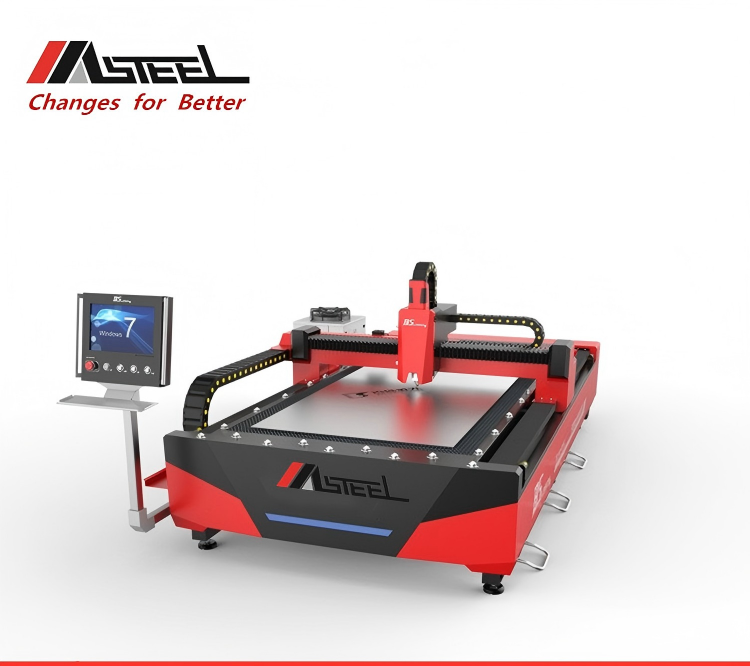
Fangyu's standard CNC laser cutting machine lineup uses fiber laser sources from 1 kW to 30 kW. Common configurations include:
- 1–3 kW: Ideal for thin-gauge sheet metal, signage, HVAC, electrical enclosure manufacturing
- 6–12 kW: Covers most industrial fabrication — 3–12 mm mild steel and stainless at high speed
- 15–30 kW: For heavy fabrication shops cutting 12–40 mm plate at production volumes
Bed sizes are available from 2,000 × 1,000 mm to 6,000 × 2,500 mm, with options for single and dual table configurations.
Our sales team matches power, bed size, and assist gas configuration to your actual production profile — not a standard spec sheet.
Ready to compare fiber laser options for your production needs?
Send us the following to get a matched recommendation and budget estimate: - Material types you cut most (mild steel, stainless, aluminum) - Maximum material thickness you regularly cut - Working size — single part dimensions and largest sheet you need to fit - Typical daily or weekly production volume - Destination country (for voltage, certification, and shipping quotes)
Optional but helpful: a sample drawing or part list.
- Get Quote: https://www.fangyucnc.com/?pages_6/
- Talk to Us on WhatsApp: https://api.whatsapp.com/send?phone=+8615009731608
Related Machines
- Fiber Laser Cutting Machine
- Recommended for metal-focused fabrication shops that need higher speed and lower running cost.
- CO2 Laser Cutting Machine
- Useful reference for buyers comparing mixed-material capability and legacy CO2 workflows.
- Laser Plate Cutting Machine
- A broader Fangyu laser route for factories handling larger sheets and production-scale plate work.